
Key Takeaways
- Modern Lexus vehicles use a 17-character VIN that identifies a specific vehicle and key manufacturing details.
- Characters 1–3 identify the manufacturer and vehicle type, while characters 4–8 describe manufacturer-defined vehicle attributes.
- Character 9 validates the VIN, character 10 identifies the model year, and character 11 identifies the assembly plant.
- A Lexus VIN identifies key vehicle details, but it does not contain every factory option or the original MSRP. A Lexus window sticker or factory record can provide additional configuration and pricing information.
A Lexus VIN decoder helps identify the vehicle behind a 17-character Vehicle Identification Number. Depending on the Lexus and model year, decoding can reveal the model, engine, body type, model year, assembly plant, and other manufacturer-defined details.
This matters when checking a used-car listing, ordering parts, researching recalls, or verifying that a vehicle matches its paperwork. However, the VIN does not contain every factory option or the original MSRP.
This guide explains how to decode a Lexus VIN correctly and when you need additional factory information.
What Is a VIN and Why It Matters for Lexus Owners
A VIN is a standardized identification number assigned to a vehicle. ISO 3779 defines the international structure used for vehicle identification, while U.S. regulations require a 17-character VIN for modern vehicles. NHTSA's vPIC system is designed for model years 1981 and newer.
Lexus launched in the United States after the modern 17-character system was already established. As a result, U.S.-market Lexus vehicles use this standardized VIN format.
A Lexus VIN can help identify:
- Manufacturer and vehicle type
- Model or vehicle line
- Engine family
- Body or restraint information
- Model year
- Assembly plant
- Production sequence
It can also be used to search NHTSA recall information or manufacturer-reported vehicle data.
The VIN does not work like a complete factory options list. A Lexus window sticker or detailed factory specification record may add trim, packages, colors, options, and original pricing.
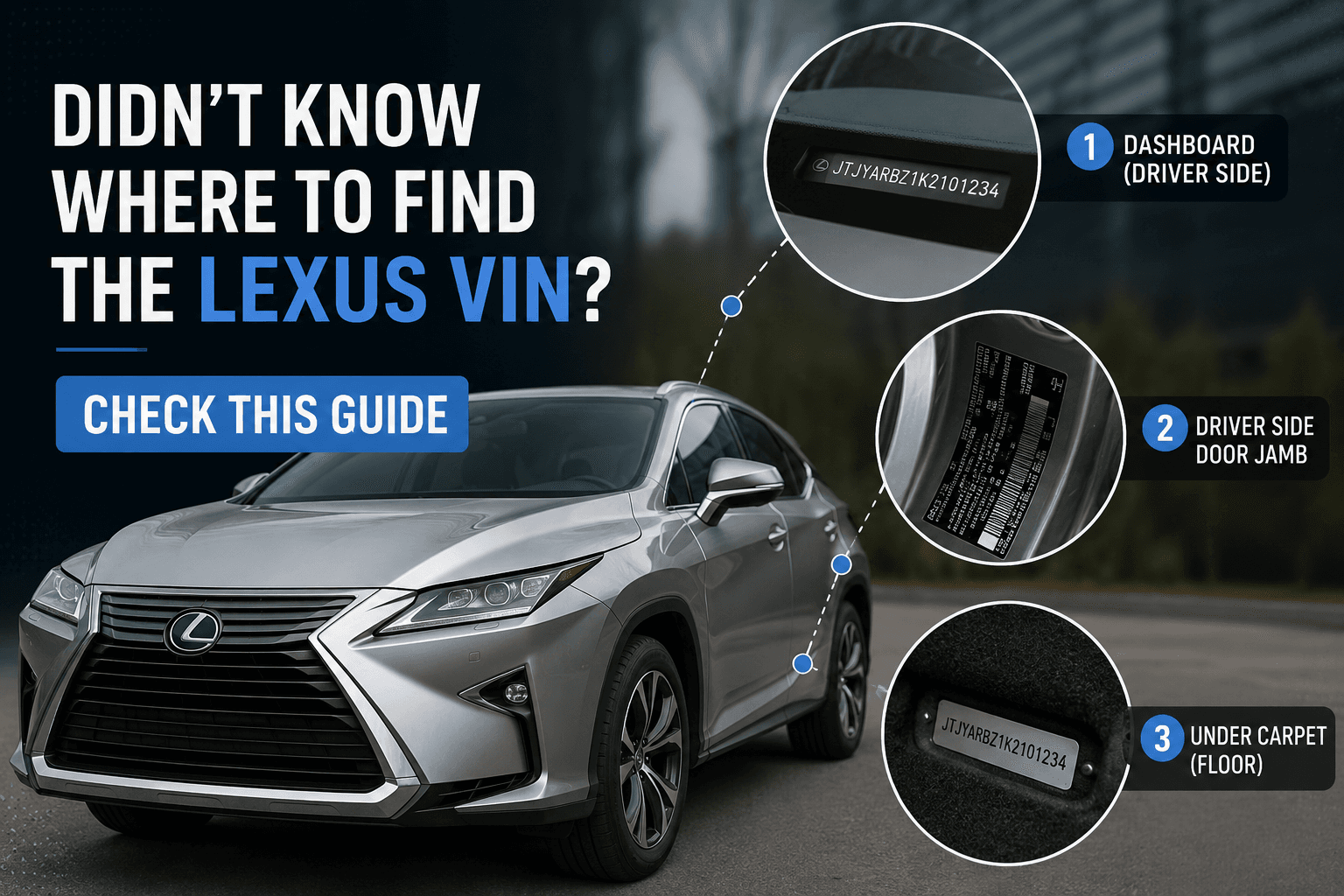
You can usually find the VIN on the lower driver-side dashboard, visible through the windshield. It also appears on the driver's door-area label, title, registration, and insurance documents. Lexus warranty materials also identify the VIN as a 17-digit number located on the dashboard.
How to Decode a Lexus VIN Step by Step
The easiest way to decode a Lexus VIN is to start with the complete number rather than trying to interpret isolated characters. Lexus VIN coding varies between models and production years.
Step 1: Find the VIN
Copy all 17 characters exactly from the vehicle or official paperwork.
Check More Than One VIN Location
For a used Lexus, compare the dashboard VIN with:
- Door-jamb or certification label
- Registration
- Title
- Insurance documents
Step 2: Enter the VIN
Use a reputable Lexus VIN decoder to interpret the information encoded in the 17-character VIN. A decoder can help identify details such as the model year, vehicle type, engine-related information, and assembly plant, depending on the Lexus model and available manufacturer data.
Step 3: Check Additional Vehicle Information
Review the decoded model year, model, engine, body type, and plant first.
If you need original equipment or pricing, move beyond basic decoding. A Lexus Window Sticker by VIN, factory specification record, safety ratings, and more.
Lexus VIN Structure: Breaking Down All 17 Characters
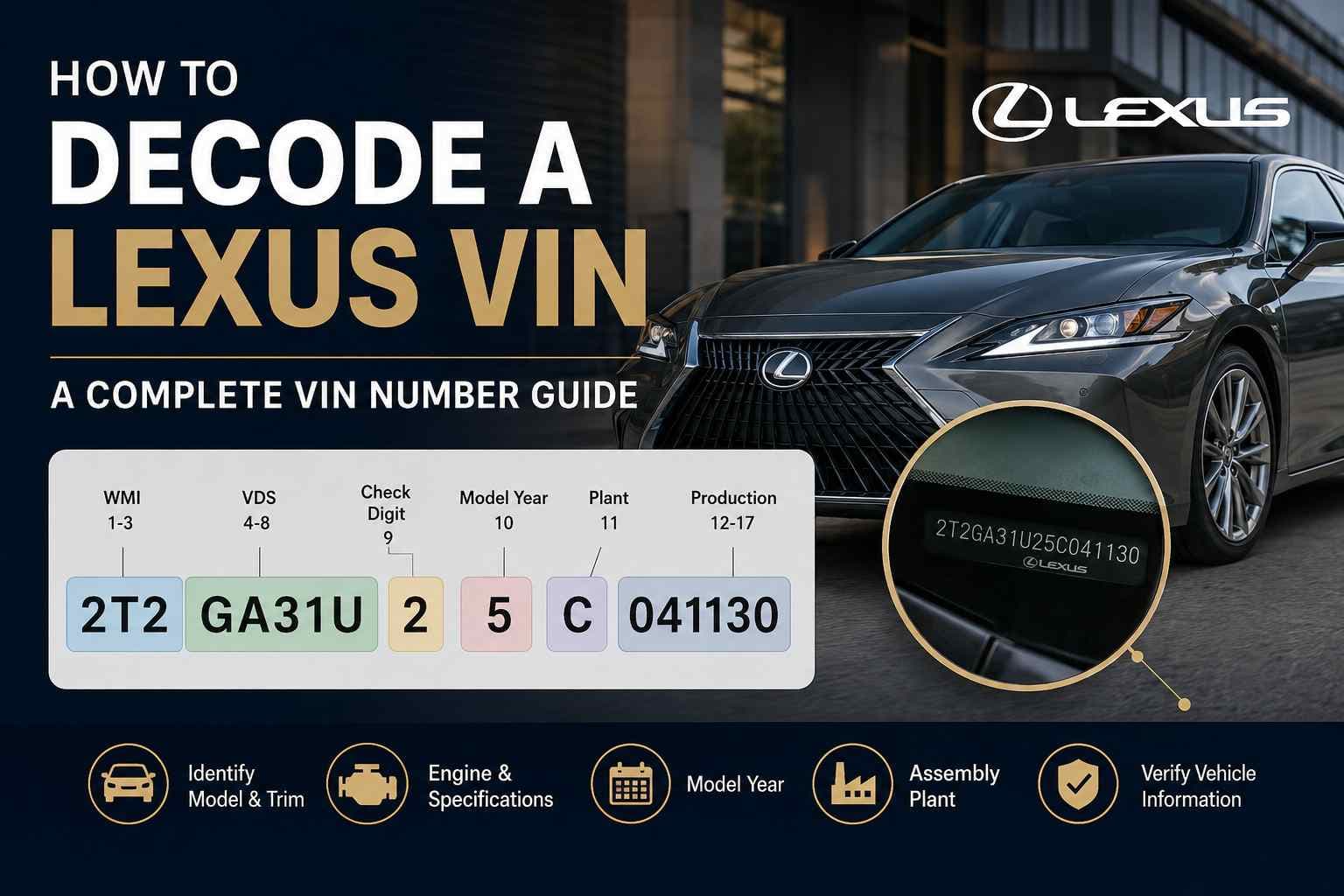
A Lexus VIN number decoder reads the VIN in several sections. The broad structure follows federal VIN rules, although Lexus decides the detailed meaning of many characters within those sections.
Consider this example VIN:
2T2GA31U25C041130
Lexus technical documentation identifies the 2T2GA31U pattern as a Canadian-built RX 330 with two-wheel drive. The tenth character, 5, identifies model year 2005. The eleventh character, C, relates to the Canadian production plant used for these vehicles.
| VIN Characters | Section | What It Generally Tells You |
|---|---|---|
| 1–3 | World Manufacturer Identifier | Manufacturer, region and vehicle type |
| 4–8 | Vehicle Descriptor Section | Manufacturer-defined body, engine, series and related attributes |
| 9 | Check digit | Mathematical VIN validation |
| 10 | Model year | Model-year code |
| 11 | Plant | Assembly plant code |
| 12–17 | Production sequence | Vehicle-specific production sequence |
← Scroll horizontally to see more →
Characters 1–3: World Manufacturer Identifier (WMI)
The first three characters form the World Manufacturer Identifier.
SAE's WMI system provides a standardized method for assigning manufacturer identifiers. Its purpose includes identifying vehicle origin and preventing duplicate manufacturer codes.
Examples found in Lexus include:
- JTH for certain Japan-built Lexus passenger cars
- JTJ for certain Japan-built Lexus multipurpose vehicles
- 2T2 for certain Lexus RX vehicles built in Canada
For example, Lexus documentation for the GS F identifies JTH as a Toyota Motor Corporation WMI used for a Lexus passenger car. Lexus service records identify both JTJ and 2T2 prefixes for different RX production locations.
Do not assume that every Lexus VIN begins with JT. The prefix depends on the vehicle and where it was manufactured.
Characters 4–8: Vehicle Descriptor Section (VDS)
These positions can describe manufacturer-defined attributes such as:
- Body type
- Engine
- Restraint system
- Series
- Model or vehicle line
- Drivetrain-related information
The exact position-to-feature relationship is not universal across every Lexus.
For example, Lexus's manufacturer-submitted GS F decoding information assigns position five to the engine and position eight to the Lexus GS F vehicle line. Other Lexus models can use different codes.
Character 9: Check Digit
Character nine is the check digit.
It does not tell you the trim, color, engine, or model year. Instead, it is calculated from the other VIN characters using a mathematical formula.
Character 10: Model Year Code
The tenth character identifies the vehicle's model year under the standardized U.S. coding system.
Examples include:
| Code | Model Year | Code | Model Year |
|---|---|---|---|
| A | 2010 | B | 2011 |
| C | 2012 | D | 2013 |
| E | 2014 | F | 2015 |
| G | 2016 | H | 2017 |
| J | 2018 | K | 2019 |
| L | 2020 | M | 2021 |
| N | 2022 | P | 2023 |
| R | 2024 | S | 2025 |
| T | 2026 |
← Scroll horizontally to see more →
The letters I, O, Q, U, and Z are skipped in this model-year sequence. NHTSA manufacturer documentation confirms the current sequence through 2026.
Why Model-Year Codes Repeat
The VIN year-code cycle repeats after 30 years.
For example, B represented 1981 and again represents 2011. It can represent 2041 in the next cycle. You therefore cannot identify a vehicle's age from character ten alone. The complete VIN, model, production context, and other positions resolve the correct cycle.
Characters 11–17: Plant Code and Serial Number
The last section identifies where the Lexus was assembled and distinguishes it within production.
Character 11: Assembly Plant
Lexus plant codes are model-specific. For example, Lexus manufacturer documentation identifies plant codes for facilities such as Motomachi, Tahara, and Yoshiwara on applicable models.
Characters 12–17: Production Sequence
The remaining six characters form the vehicle's production sequence within the applicable VIN system. They help distinguish one Lexus from another. However, you cannot use these six digits alone to determine the exact trim or option package.
A VIN decoder and a Lexus build sheet answer different questions.
A Lexus VIN decoder interprets information encoded within the 17-character VIN and manufacturer-submitted decoding rules. A build sheet or factory specification record uses additional vehicle-specific records to describe how the individual Lexus was equipped.
| Information | VIN Decoder | Build Sheet / Factory Record |
|---|---|---|
| Manufacturer | Yes | Yes |
| Model year | Yes | Yes |
| Model/body type | Usually | Yes |
| Engine family | Usually | Yes |
| Assembly plant | Usually | May include |
| Exact trim | May vary | Often more detailed |
| Factory packages | Usually no | May include |
| Individual options | Usually no | May include |
| Exterior/interior specification | Limited | May include |
| MSRP | May be available through additional vehicle data | May be available |
← Scroll horizontally to see more →
The VIN does not contain a hidden list of every heated seat, wheel package, paint color, or premium audio option. The VIN can be used as a key to find records associated with the specific vehicle.
If your goal is simply to verify that an advertised Lexus IS is the correct year and engine, decoding may be enough.
Decoding a European-Market Lexus VIN
A Lexus VIN decoder for Europe requires extra care.
ISO 3779 provides an international VIN framework, but manufacturer coding and database coverage can differ between markets. A European-market Lexus should therefore be decoded using a service that supports its specific market and manufacturer records.
Do not assume that a specific European WMI such as SB1 automatically means Lexus. SB1 is associated with Toyota's U.K. manufacturing operations and is commonly found on Toyota models rather than serving as a universal European Lexus prefix.
Frequently Asked Questions
Where Can I Decode My Lexus VIN for Free?
NHTSA provides a free VIN decoder for vehicles within its database. It can identify manufacturer-reported information encoded in the VIN, including model and plant details where available. A commercial Lexus VIN decoder may provide additional information from other records, but the depth varies by service.
Does the Lexus VIN Tell Me What Factory Options My Car Has?
Not usually by itself. The VIN contains specific identification and vehicle-description codes, but it does not directly list every factory option. A Lexus Window Sticker or factory build record can provide more detailed equipment information when vehicle-specific records are available.
Can Two Lexus Vehicles Have the Same VIN?
Two legitimate vehicles should not share the same complete 17-character VIN. The VIN is designed to uniquely identify a vehicle. Individual character groups can be shared across many Lexus vehicles, but the complete VIN distinguishes the specific vehicle.
Where Can I Discuss or Verify My VIN Decode With Other Owners?
Lexus enthusiast communities such as ClubLexus can be useful for discussing unusual VIN codes, production changes, and model-specific details. Treat forum posts as supporting information rather than an official source. For technical verification, manufacturer documentation and NHTSA records are stronger sources.
Is a Lexus VIN Decoder Different From a Toyota VIN Decoder?
The basic VIN structure follows the same standards, and Toyota Motor Corporation manufactures Lexus vehicles. However, Lexus uses its own vehicle lines, model codes, engines, and manufacturer-submitted decoding patterns. A Lexus-specific decoder is therefore better suited to interpreting Lexus models accurately. NHTSA lists Lexus among Toyota Motor Corporation's reported makes.